

The Hidden Cost of Managing Vacation Rental Email Yourself
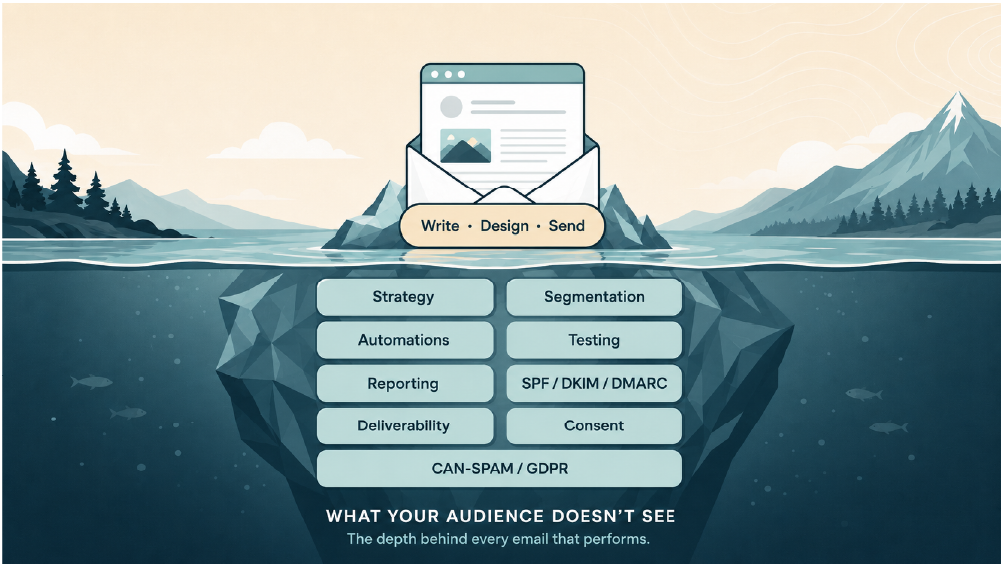
Email is one of the few marketing channels vacation rental companies truly own. That's exactly why so many businesses convince themselves they can run it on their own. You've got a platform, you can write a subject line, you can hit send. How hard can it be?
Here's the honest answer: sending an email is easy. Building an email program that consistently makes you money is not. That gap is where most DIY efforts quietly stall out — and it's the gap a good vacation rental marketing agency exists to close.
We're Switchback Email Marketing, so yes, we have a horse in this race. But we'd rather make the real case than the hype one. Here's how doing it yourself actually compares to bringing us in.
The "free" version is not free
When you manage email internally, you may not see an agency fee on an invoice.
Instead, you pay with your time or your team’s time.
A single campaign can require strategy, copywriting, design, segmentation, testing, scheduling, troubleshooting, and reporting. Multiply that across newsletters, promotions, property announcements, and automated flows, and email quickly becomes a part-time job.
That is before an occupancy gap, owner request, or last-minute offer gets added to the calendar.
The visible cost is the time spent building campaigns.
The hidden cost is everything else your team is not doing while building them.
Under those conditions, email often becomes rushed, generic, and inconsistent. Then the results disappoint, and the conclusion becomes, “Email does not work for us.”
More often than not, email was never given the time or ownership it needed to work.
Your platform does not come with a strategy
Email tools are sold on features: drag-and-drop builders, automation flows, and templates. What they don't give you is a point of view on your business — when to send, what to say, who to say it to, and what to stop doing.
That's the actual work. A welcome series that earns trust instead of begging for a sale. A win-back flow that pulls dormant customers back before you've spent money re-acquiring them. Segmentation so your best customers aren't getting the same blast as someone who bought once two years ago.
This is judgment built from having done it across many accounts, not something a template can hand you. It's the difference between having email and running an email program.
Deliverability: the silent revenue killer
Here's the issue almost no DIY sender sees coming. You can write the perfect email, and if it lands in spam, none of it matters.
Deliverability is its own discipline. It includes domain authentication, proper warming, list hygiene, sender reputation, and recognizing the early warning signs before major inbox providers begin filtering your messages.
That authentication includes:
- SPF, which identifies the systems authorized to send email from your domain
- DKIM, which adds a digital signature that helps verify the message is legitimate
- DMARC, which tells inbox providers what to do when a message fails those checks
These settings become especially confusing when your website, property management system, reservation platform, and email software may all send from the same domain.
Most people managing email themselves do not realize they have a deliverability problem until open rates have already cratered. By then, the damage to their sender reputation can take weeks—or longer—to repair.
We treat inbox placement as a core part of the job, not an afterthought. Keeping your emails out of the spam folder is often where the largest, least obvious gains live.
You don't just need data — you need to know what to do with it
Every email platform gives you metrics. Opens, clicks, conversions, and unsubscribes. The dashboard isn't the hard part.
Knowing what those numbers are telling you to change is the hard part.
Is a low open rate a subject-line problem or a deliverability problem?
Is a high unsubscribe rate a sign you're emailing too often, or emailing the wrong people?
DIY senders usually have plenty of data and very little signal. A good chunk of what an agency does is turn one into the other — running real tests, reading the results correctly, and feeding what works back into the next send.
Compliance is boring until it's expensive
CAN-SPAM, GDPR, consent management, and proper handling of unsubscribe requests are not optional parts of email marketing.
They are also easy to misunderstand.
Compliance can include:
- Knowing how each person entered your list
- Maintaining accurate consent records
- Providing a clear, working unsubscribe option
- Using guest data only in permitted ways
- Keeping preferences synchronized when contacts move between platforms
This gets more complicated when guest information passes between your website, property management system, reservation platform, lead forms, and email software.
These details are easy to overlook when your team is focused on the next campaign. They are also easy to get quietly wrong in ways that create unnecessary risk for your business.
Handling authentication, consent, and unsubscribe management properly is table stakes for us—and one less category of confusion on your team’s plate.
When you should keep it in-house
We'll be straight with you, sometimes you are the best person to do this job! Doing it yourself can be the right call when:
- You're very early, sending occasionally, and just need to keep a small list warm.
- You already have a skilled in-house email marketer with real bandwidth.
- Email is genuinely a minor channel for your business and likely to stay that way.
If that's you, a platform and some discipline may be all you need. An agency earns its fee when email is — or could be — a meaningful revenue driver, and the gap between what you're getting and what's possible is wider than the cost of closing it.
What you're actually buying with Switchback
When you bring us in, you're not paying for someone to send emails.
You are buying ownership of the channel from a team that understands vacation rental booking behavior.
This includes:
- A strategy built around your business and your customers, not a template.
- Consistent, well-crafted campaigns and automated flows that run whether or not you have a free evening.
- Deliverability handled by people who watch it for a living.
- Testing and optimization that compound over time instead of resetting every send.
- Reporting that tells you what to do next, in plain language.
- Your own time and attention back, pointed at the parts of the business only you can run.
Depending on your needs, that may mean fully managed vacation rental email marketing, hybrid support, or a stronger structure for your internal team.
The goal is not to force every business into the same service model.
It is to give email the level of ownership it deserves.
The bottom line
The question was never really "agency or DIY." It's "what is this channel worth to my business, and am I leaving money on the table by treating it as an afterthought?"
If email is a side task you squeeze in between everything else, that's usually exactly how it performs. If you want it to pull real weight, it needs real ownership — either a dedicated person in-house or a team like ours who does this all day, every day.