

Five Email Types—and What Belongs in Each
In our last post, we walked through the five core emails every vacation rental should be sending: the monthly newsletter, the new property alert, the owners' email, the single-focus postcard email, and the sale or promotion email. Knowing which email to send is half the battle. The other half — the part that trips most people up — is figuring out what to actually put inside it.
A blank email is intimidating. But once you understand the job each email is doing, the content almost writes itself. Below is a practical guide to thinking about content for each type, including where to find ideas when you feel stuck in your vacation rental email marketing.
1. The Monthly Newsletter: Be the Local Insider
The mindset for newsletter content is simple: what would a well-connected local friend tell a visitor? Your readers subscribed because they're interested in your destination, not just your properties. So the content should feel like helpful, in-the-know dispatches rather than a sales flyer.
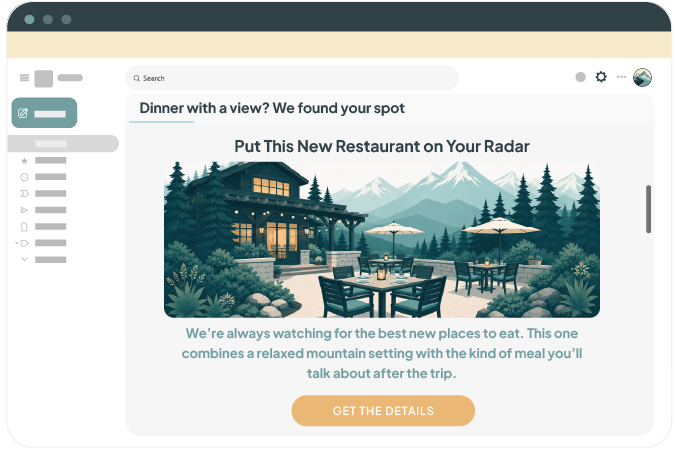
Think in terms of recurring "buckets" you can rotate through each month so you never start from scratch:
- What's happening: seasonal events, festivals, farmers markets, concerts, holiday happenings.
- Where to go: a new restaurant, a hidden hike, the best spot to catch a sunset, a rainy-day backup plan.
- Travel inspiration: "Why fall is the quiet season's best-kept secret," packing tips, and itineraries for different types of travelers.
- Behind the scenes: a staff favorite property, a guest story, and a small peek at how you care for the homes.
When you're stuck for vacation rental email marketing ideas, look at the calendar and the season first. Almost every month has a natural hook — a holiday, a weather shift, the start of a local event series. Build the issue around that, then sprinkle in one featured property and a soft invitation to browse dates.
2. The New Property Alert:
Sell the Experience, Not the Listing
The content trap here is describing a property like a real estate listing — square footage, number of bathrooms, a dry feature list. That's not what gets someone to book. Instead, help the reader picture themselves there.
Lead with the single most exciting thing about the home and the kind of trip it makes possible. Is it the wraparound deck with mountain views where you'd drink your morning coffee? The walk-to-the-beach location? The fact that it finally fits a group of twelve, so the whole family can stay under one roof?
A strong content recipe for these:
- The hook: one sentence that captures why this property is special.
- The "who it's for": paint the ideal trip — a couple's retreat, a multi-family reunion, a remote-work getaway.
- The standout features: the two or three things that genuinely differentiate it, framed as benefits ("soak in the hot tub after a day on the slopes") rather than specs.
- The nudge: new properties book fast, so an honest line about reserving prime dates early.
Let the photos do most of the talking. Your words are there to add emotion and context, not to repeat what the images already show.
3. The Owner's Email:
Lead With Transparency and Results
Content for owners is a different language entirely. These readers aren't dreaming about a vacation — they want to know their investment is in good hands and performing well. The mindset is proactive transparency: tell them what they want to know before they have to ask.
The backbone of owner content is data and outcomes:
- Performance: occupancy, revenue, booking pace, and how they compare to the same period last year.
- Market context: what's happening with demand, rates, and seasonality in your area, and what it means for them.
- What you're doing: the marketing, maintenance, and guest-experience work happening on their behalf.
- What's next: upcoming bookings, seasonal strategy, anything they should be aware of or plan for.
The tone should be confident and clear. Even when news is mixed — a slower month, a maintenance issue — addressing it head-on with a plan builds far more trust than glossing over it. Every owners email is quietly answering one question: "Did I make the right choice partnering with you?" Good content keeps the answer a confident yes.
4. The Single-Focus (Postcard-Style) Email:
One Idea, Ruthlessly Edited
Content for the postcard email is mostly an exercise in subtraction. The whole format works because it does one thing. So before you write a word, decide on the single message and the single action you want.
Once you have that, the content is tiny by design:
- One image that carries the emotion. This is doing 80% of the work, so choose it carefully.
- One headline — short, evocative, specific. "Last few fall weekends in the mountains" beats "Check out our availability."
- A line or two of supporting copy, no more.
- One button with clear, active text.
The discipline is in what you leave out. If you find yourself wanting to add a second property, a secondary link, or "while you're at it" copy — stop. That's a sign the message belongs in a newsletter, not a postcard. The power of this format is its focus. The result is increased direct bookings.
5. The Sale / Promotion Email:
Make the Offer and the Clock Obvious
For promotional content, clarity beats cleverness every time. The reader should understand the deal, the deadline, and what to do — within about three seconds of opening. The mindset is to remove every ounce of friction and ambiguity.
The essential content elements:
- The offer, stated plainly: the specific discount or perk. "20% off" is stronger than "great savings."
- The deadline or limit: a real-time window or limited availability that gives a reason to act now.
- The value reminder: a quick line on why this trip is worth taking, so it's not only about price.
- A short, obvious path to book: one clear button, repeated if the email runs long.
Put the offer and the deadline in the subject line, then reinforce both in the body. And a word of caution on content integrity: only create urgency that's real. "Only a few weekends left" should be true. Travelers are savvy, and a promotion that cries wolf erodes the trust that the rest of your emails work hard to build.
A Few Principles That Apply to Everything
No matter which email you're writing, a handful of content habits will serve you well:
- Write for one person. Picture a specific reader and talk to them, not to a list.
- Lead with the benefit. Open with what's in it for them, not with logistics.
- Let the destination shine. People book a feeling — relaxation, adventure, togetherness. Sell that.
- Keep one clear action per email. Even content-rich newsletters should make the next step obvious.
The best part is that good content compounds. A great photo, a clever subject line, a piece of local insight — these can be reused and remixed across email types, your website, and social. Start with the job each email is doing, fill it with content that serves that job, and your inbox presence will start working as hard as your properties do.